
This Week:
- The
Liselec Service Celebrates Its First Year of Operations in La Rochelle
With More than 250 Members and 15,000 Trips Taken
- Ford
of Canada delivers first TH!NK city electric vehicle in Canada to
Ballard Power Systems
. - The
BMW 3 Series And The X5 Recognized As Vehicles "That Most
Excite" Their Owners
. - New Head of DaimlerChrysler Investor Relations
- Chevy's
Midsize Car Lineup Beats Major Competitors
. - Federal-Mogul
Announces Leadership Change and Reduction In Third Quarter Earnings
Estimate
.
© 1998
- 2000 Copyright &
Disclaimer
Automotive Intelligence,
www.autointell.com
All Rights Reserved .
For questions please contact
editor@autointell.com

News of September 26, 2000
|
The
New Fiat Palio, Fiat Palio Weekend And Fiat Siena |
|
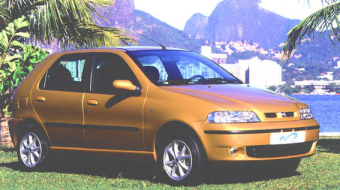
Fiat Palio Photo: Fiat |
|
Turin
- Italy and Brazil again join forces to bring us a car (or rather a
family of cars) that constitutes a veritable distillate of innovation,
style and engineering. The creativity and automotive know-how that
made the Fiat Palio, Palio Weekend and Siena an unprecedented success
on the Brazilian market have been revived to offer cars with updated
style and content just four years after the initial launch. This is a
sign of great vitality and an ability to offer a fast response to
customer requirements - or even to pre-empt them. Four
years ago, Brazil was the stage for the world launch of the Fiat Palio,
the first 'world car' to be produced and launched locally. The
up-to-date design of this model introduced new standards for this type
of car in the country and the Palio immediately established itself as
a benchmark in its segment for safety, performance, style and quality.
The
models in the Fiat Palio family went on to become a world success.
More than one and a half million have been sold to customers in 41
markets (including Germany, Italy, France, Spain, South Africa,
Morocco, Russia, Vietnam and India). The car is produced in ten
countries and sold in and exported to another 31. Nowadays the Fiat
Palio, Palio Weekend and Siena are present in four continents and
Brazil accounts for 80% of total Palio family model production. These
figures serve to emphasise Brazil's importance within the world
motoring industry. Fiat
therefore decided to give the 178 family a major facelift and bring in
new standards of quality and engineering with the aim of consolidating
and extending its presence in Brazil and other markets where the Palio
is already a success. The
three profoundly different cars we see today are the outcome of
in-depth research, innovative research, exhaustive testing and
investment in up-to-date production processes. The three cars
guarantee high standards of quality and engineering and represent a
true qualitative leap as far as good looks, comfort, safety and
performance are concerned. Traditional,
demanding customers and also customers who seek practicality and
driving satisfaction will all be able to meet their present and future
needs from the Palio family. Fiat
Auto is offering all-new cars with its Fiat Palio, Palio Weekend and
Siena 2000 range. Suffice it to say that 80% of the components have
been changed. The Brazilian market From
the end of 1997 to the beginning of 2000, car sales plummeted in
Brazil as a result of the economic crisis suffered by the country. New
manufacturers also entered the Brazilian market at the same time. Yet
Fiat succeeded in holding on to a share equal to 25% of the total
market. In
Brazil, segment A, i.e. cars with capacities up to 1000 cc, accounts
for more than half of new car sales and thus attracts the attention of
all local manufacturers. Despite the launch of new models and lively
competition, the Fiat models occupy a position of great importance
within this segment.With the advent of the new Palio, Fiat aims to
become the high volume production car leader. Fiat
significantly increased its share of segment B when it launched a Fiat
Palio with a 1.3 16v engine. This car has stood its ground in the face
of dangerous rivals. The new Fiat Palio with 1.3 16v or 1.6 16v
engines represents an excellent response to different customer needs
within this market band. Fiat's
position in segment C1, i.e. the compact saloon segment, is reinforced
by the launch of the new Siena. The company aims to absorb some 25% of
this market. The
compact station wagon segment, segment Cw, has grown in importance in
recent years. Much of this growth has been due to the launch of the Fiat Palio Weekend, which has updated the image of these
cars. The model swiftly became the leader in this segment and
consolidated its position by launching innovative versions such as the
Adventure. This position will almost certainly be reinforced by the
arrival of the new Fiat Palio Weekend. Fiat
Automóveis, biggest manufacturer in Brazil Fiat
Automóveis is the youngest of the four big Brazilian manufacturers
and Fiat Auto's biggest automotive unit outside Italy. Recently it
achieved an important goal when it became the biggest manufacturer in
the country (33% of national production) and leader in car sales
within the Southern Cone Common Market, Mercosul. This result was
achieved as a result of Fiat's ability to innovate at all times and in
everything: engineering, safety and customer service. Another
example of Fiat Automoveis's success is represented by the percentage
growth recorded during the period between 1981 and 1999: while the
market grew by 225%, Fiat's growth over the same period was 497%.
The
Betim plant in the state of Minas Gerais, Brazil went into operation
on July 9, 1976. Fiat has been responsible for building up one of the
country's main industrial centres around the plant. It accounts for
some 10% of Gross Domestic Product for the State of Minas Gerais and
has created 20,500 jobs, including 11,500 direct jobs and 9000
indirect jobs. A further 50,000 jobs have been created within
dealerships and suppliers. Current
daily production is 1740 cars and 1200 engines per day and the company
continues to invest in new technology and products. $ 1.5 billion were
invested during the period between 1997 and 2000 and the range of new
ventures included two new factories: one producing FIRE power units
and an IVECO-FIAT light commercial vehicle production plant. Fiat's
presence in Brazil has always been marked by innovation. Examples
include the first car to run on alcohol in Brazil, the first pick-up
derived from a saloon, the first one-litre engine, the first 16 valve
power unit, the first turbo engine, the first car with an airbag and
the first five cylinder engine. Fiat was also responsible for
introducing a six speed gearbox to the country and the first small
pick-up with a long cab. And now its new people's car is going from
strength to strength. The
choice of Brazil as a base for the launch of the Palio world car also
brought Brazil into the wider scenario of the world motor industry.
Setting
trends Fiat
is not just innovative as far as products are concerned. During its 24
years of production in Brazil, the company has always been bold enough
to take the initiative and sometimes even to set trends. For example,
it gained two international certifications ISO 9002 and ISO 14001
simultaneously. And it also launched the Autonomy programme that made
Fiat the first and only manufacturer to product a factory-built car
for the disabled. And Fiat's Youth programme is linked with a series
of initiatives that will involve 10 million public and private school
students throughout the country this year. Fiat
- which has been made an Honorary Citizen of Betim - invests more than
5 million Reais each year in social and educational campaigns and its
Perpetual Motion programme (a branch of the Fiat Youth program) plays
an important part in supporting the education and training of
Brazilian students. The programme takes the form of a set of
up-to-date teaching materials (distributed free to schools in the
country) that are designed to prompt classroom debate on the important
topics of alcohol and drug abuse, road rage and environmental
protection. (September 23, 2000) |
[Homepage] [
News] [ Companies] [
Management] [ Publications]
[ Events] [ Careers]
[Services] [Discussion] [
Guestbook]
[ Search]