
This Week:
© 1998
- 2000 Copyright &
Disclaimer
Automotive Intelligence,
www.autointell.com
All Rights Reserved .
For questions please contact
editor@autointell.com

News of June 27, 2000
.
| Ford delivers
15,000th Bi-fuel vehicle to U.S. Department of Energy . |
|
15,000th bi-fuel vehicle delivered to Department of Energy
Executive Order 13149 requires federal fleets to reduce petroleum consumption 20 percent
by 2005 High pump
prices have more people looking at natural gas and propane as alternatives
|
|
| DEARBORN,
Mich. - Ford Motor Company announced a major milestone in the sale of alternative fuel
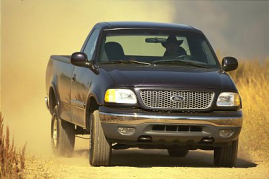
vehicles today, as the 15,000th bi-fuel vehicle rolled off the line. The vehicle is a
bi-fuel natural gas F-150 pickup truck and will be delivered to the Department of Energy.
|
F-150 Photo: Ford |
Thomas J. Gross, U.S. Department of Energy deputy
assistant secretary, accepted delivery of the vehicle from Les Grey, assistant
commissioner, U.S. General Service Administration. "The
Department of Energy and GSA have shown exceptional leadership in purchasing and using
alternative fuel vehicles," said Lee Oliphant, Ford Government Fleet Sales manager.
"It is only appropriate that the delivery of the 15,000th bi-fuel vehicle is to the
U.S. General Services Administration and the Department of Energy." Since 1996 the
GSA, which orders equipment and supplies for a wide range of U.S. government agencies
including the Department of Energy, has purchased or leased more than 4000 bi-fuel natural
gas or propane vehicles from Ford. The bi-fuel
propane (LPG) and natural gas trucks are built at Ford's Ontario Truck Plant in Oakville,
Ontario and then shipped to GFI Control Systems, Inc. in Cambridge, ON for installation of
alternative fuel tanks and fuel systems. To achieve
reduction in fuel consumption, federal agencies must use alternative fuels in bi-fuel or
flexible-fuel vehicles the majority of the time, increase the average EPA fuel economy
rating of their light-duty vehicle fleet acquisitions by at least one mpg in 2002 and
three mpg by 2005, and improve overall fleet efficiency. As part of the Executive Order,
federal agencies must submit a compliance plan to the Department of Energy by November,
2000. Alternative fuel
vehicles are receiving another boost this summer in the form of higher gas prices at the
pump. Consumer interest in alternative fuel vehicles (AFVs) has risen as retail gasoline
prices have climbed to record highs. Alternative fuels usually cost less than gasoline,
but that gap has grown significantly in recent months as gasoline prices have soared. "Large
vehicle fleets are among the first to feel the impact of rising gas prices. There is a lot
of concern from fleet operators regarding the effect increasing gasoline prices will have
on their businesses," said Oliphant. "Fleet managers who ordered AFVs this
spring are finding that their decision is paying off faster than expected because, while
gasoline prices are rising, the cost of alternative fuels is holding steady." Since 1996, sales
of dedicated and bi-fuel natural gas vehicles have grown nearly 25 percent a year. In
addition, dealers and retail consumers have begun showing increasing interest in AFVs over
the last few months. In North America,
Ford offers 10 models of vehicles that operate on natural gas, propane, electricity, or
E85 (ethanol). The partnership
between Ford and GFI to build bi-fuel natural gas and propane vehicles began in 1994 with
the bi-fuel natural gas F-150. Over the years, the partnership has expanded to include the
bi-fuel natural gas Ford Contour, the bi-fuel LPG F-150 pickup truck and the bi-fuel LPG
Super Duty F-Series. (June 26,
2000) |
|
[Homepage]
[ News] [ Companies] [ Management] [ Publications] [ Events] [ Careers]
[Services] [Discussion] [ Guestbook] [ Search]