|
|
 |
 |
||||||||
|
Automotive Intelligence - the web for automotive professionals and car enthusiasts |
|||||||||
|
November 14, 2011 This Week:
© 1998 - 2011
Copyright & |
State-of-the-art facilities for innovative vehicle production. To ensure the utmost precision and efficiency, new production structures were created for all the manufacturing areas.
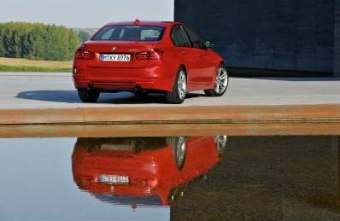
Building the sixth generation of the BMW 3 Series thus benefits, for example, from a new large press. At 17 strokes per minute, this installation counts among the most advanced in the world. It achieves throughput of 600 tonnes of steel per day and develops press forces of 650 to 2,500 tonnes. In a matter of 12 days, then, this high-performance facility processes a similar amount of steel as went into the construction of the Eiffel Tower in Paris. The new production infrastructure also ensures the highest possible economy of space and optimal material flows. Beyond that, the high-tech press enables an improvement in quality and efficiency. Latest-generation robots are at work in the body shop and paintshop. For the production of the BMW 3 Series, the old, low-rise body shop had to be demolished to make way for a completely new production building. At the same time, numerous new robots were installed, some of which had previously been operating at the Leipzig plant. Synergies such as this make a noticeable contribution to cutting costs and ensuring the sustainable use of resources. In addition, latest-generation laser robots and advanced bonding robots are being used. This modern, low-temperature process is now being used on the BMW 3 Series for around twice as many operations compared to its predecessor, in part replacing conventional spot welding. The innovative technique significantly improves sealing and corrosion prevention. The stiffer body of the new BMW 3 Series offers significantly enhanced driving dynamics, comfort and safety, even though it is up to 45 kilograms lighter than its predecessor. In the paintshop, new robot facilities have been installed for seam sealing, flange sealing and undersealing. There is also a new foaming machine for firewall sound insulation. This feeds the sound-insulating material into the cavity, where it is foamed. The result is significantly improved sound insulation between the engine compartment and the passenger cell, making for a noticeable enhancement of interior comfort. High production efficiency thanks to modular product and process architecture. In the assembly shop, meanwhile, standardised modular product and process architectures ensure high productivity and variability. The production process of the new BMW 3 Series systematically applies the BMW Group strategy of multi-version production on the same main assembly line. In other words, different variants of a model series are simultaneously built on the same production line. With these innovative production processes, new manufacturing facilities and cutting-edge technologies, the Munich plant sets exemplary standards for sustainable and eco-friendly production. Among the modernisation measures is also the reconstruction of the logistics, goods inwards and commissioning centre to ensure efficient material supply to the assembly line. Clean production: manufacturing processes now virtually free of non-recyclable waste. With the new BMW 3 Series, BMW has succeeded in implementing production processes that practically eliminate non-recyclable waste and reduce the generation of solid waste, wastewater and emissions almost to zero, as well as cutting noise and vibration to a minimum. Non-recyclable waste has now been whittled down to some eight grams per vehicle. Furthermore, over 60 per cent of vehicles leaving the plant are transported or delivered by rail. With such highly efficient resource management, the Munich plant also marks a milestone for vehicle manufacturing in terms of clean production. Another key priority of the Munich plant is to cultivate good neighbourly relations. Thus great care is taken, for example, to protect local residents from noise generated by the production plant. Noise abatement measures include the use of innovative silencers, ventilation equipment and sound-absorbing cladding, as well as optimised transport logistics. Paintshop odours are avoided thanks to state-of-the-art filtering and regenerative thermal oxidisers. Beyond this, all production processes are subjected to continuous monitoring, which includes assessing the impact on local residents. Munich home plant is the birthplace of the BMW Group. Production at the Munich home plant goes back all the way to 1922. Today, around 9,000 staff from more than 50 nations are employed there. In 2010 alone, almost 206,000 vehicles rolled off the production lines in the heart an urban residential area with minimal impact on the neighbourhood and the environment. The Munich plant is an integral part of the BMW Group’s global production network and the lead plant for the new BMW 3 Series worldwide. In addition to the core facilities of the body shop, paintshop and assembly lines, the Munich plant also encompasses a laboratory, a press shop, engine construction and toolmaking, as well as interior equipment and seat manufacturing. As such, it brings together the most diverse skills and competences of vehicle production in unique and exemplary fashion. Photos: BMW (28.10.2011)
|
||||||||