|
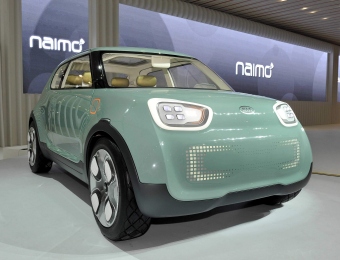
Kia’s design team also made use of
innovative technology features to give the car a premium feel
and to ensure the car’s exterior remained uncluttered. For
example, Naimo has no traditional wiper blade on the windscreen
– instead it employs a high-intensity air jet at the base of the
windscreen that performs an ‘air wiper’ function. Conventional
door mirrors have also been replaced with miniature cameras
installed in the A-pillars.
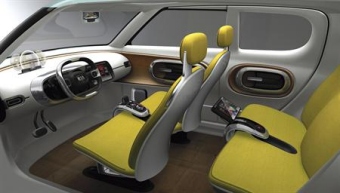
Naimo’s interior was designed to
evoke a strong sense of tranquility and features hand-crafted
materials throughout. Korean oak is used to trim the interior
door panels and the entire interior floor, Korean “Han-ji” paper
is used for the head lining. Alongside these traditional
elements sit modern features such as a TOLED (transparent
organic light emitting diode) storming display instrument panel
and full device connectivity.
The third electric vehicle design
to be unveiled by Kia Motors Corporation in a year, the
3.9-meter long Naimo concept explores the practicalities of
introducing a zero-emissions, five-door, four-seater city car
into a future niche market.
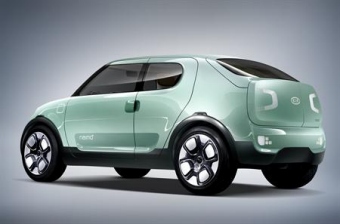
Measuring 3,890 mm in length, the
Naimo’s generous wheelbase, width and height (2,647, 1,844 and
1,589 mm respectively) – plus the short overhangs which place a
wheel at each corner – ensure that the cabin provides
exceptional head, leg and shoulder room for the occupants.
The concept car has no B-pillars
and features rear-hinged rear doors to maximize easy access to
the cabin, and a three-way split opening trunk, allows versatile
access to the load bay for varying luggage sizes.
Power comes from a PMSM (Permanent
Magnet Synchronous Motor) electric motor with a maximum output
of 80 kW (109 ps) and maximum torque of 280 Nm, enabling Naimo
to reach a top speed of 150 kph (93 mph).
A twin-pack 27 kWh battery is
located under the trunk floor and uses innovative LiPoly
(Lithium Ion Polymer) technology that offers numerous advantages
over other battery types. Equipped with this battery, Naimo
provides a driving range of 200 km (124 miles) on a single
charge. To enhance range, the showcar is fitted with special
low-drag 20-inch diameter alloy wheels.
Under the quick recharging cycle
(50 kW) the Naimo’s battery can be recharged to 80 percent of
its capacity within 25 minutes. Under the normal cycle (3.3 kW),
100 percent power is attained after five and a half hours.
Naimo will join Kia’s growing test
fleet of hybrid, electric and fuel-cell vehicles being
extensively driven in widely varying conditions to develop
future production models with zero or significantly reduced
emissions.
Venga and POP pointed the electric
way ahead
Also making their presence felt on
Kia’s Seoul Motor Show stand will be the Venga and POP electric
concepts unveiled by Kia last year at major international motor
shows in Europe – the Venga at Geneva and the POP at Paris.
The Venga EV concept car was the
same size as Kia’s regular B-segment MPV and feature an electric
powertrain placed within the existing engine bay and a twin-pack
24 kWh battery located under the trunk floor.
Unconventional features of the POP
– its side-window design, dot-pattern head and taillights,
back-lit front grille, full-length glass roof, and simplistic
looking wheels – all point to inspiration from outside the usual
automotive spheres, such as gliders and high-speed bicycles.
Inside, the purple color scheme
creates a calm and peaceful environment within the space-ship
like three-seater cabin. Behind the front bench seat, the single
rear seat is positioned at an offset angle, resulting in
remarkable legroom for a 1,740 mm wide car with a wheelbase of
just 2,055 mm.
Photos: KIA
(March 31, 2011)
|