

Automotive Intelligence - the web for automotive professionals and car enthusiasts
June 01, 2008
This Week:
-
Mercedes-Benz do Brasil is Latin America’s biggest manufacturer of commercial vehicles
-
Renault-Nissan Alliance zeros in on emission free vehicles and advanced FCV prototypes
-
Ford Opens 200th Dealership in China; Continues to Enhance Overall Customer Experience
-
Honda To Set Environmental Benchmark With Accessible Global Hybrid
-
Kia Sorento Receives Top Ranking in AutoPacific 2008 Vehicle Satisfaction Awards
© 1998 - 2008
Copyright &
Disclaimer
Automotive Intelligence,
www.autointell.com
All Rights Reserved .
For questions please contact
editor@autointell.net
|
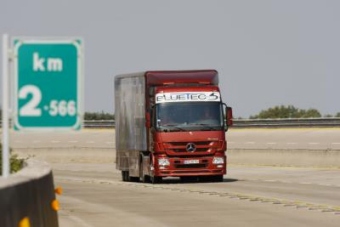
New Mercedes-Benz Actros in the Guinness Book of Records: the world's most economical series-production truck
Stuttgart/Nardo – The 40-tonne Mercedes-Benz Actros trailer/tractor combination consumes exactly 19,44 litres of diesel per 100 km or the equivalent less than 0,8 litres per hundred tonne-kilometres (tkm) – that is the outcome of a test drive 12 728,94 kilometres. A record-breaking feat that the Guinness World Records observers recognised with a world record entry in "The most fuel-efficient 40 ton truck" category. The seven-day round-the-clock test drive helped the new standard-specification Actros, hauling over 25 tonnes of payload at an average speed of 80 km/h around the test course in Nardo, prove one thing: the auto¬motive vision of the "one-litre car" (fuel consumption of approx. 0,8 l per 100 km) is already a reality in the commercial vehicle sector thanks to fuel consumption figures of 20,5 litres per 100 tkm. All of which makes sound economic sense for fleet operators in light of spiralling fuel prices, but is equally impressive from an environmental perspective: the new Mercedes-Benz Actros also reduces CO2 emissions to 20,5 grams per tonne of payload and kilometre (g/tkm). |
|
|
|
By comparison, the theoretical "one-litre car" would produce 53 g/tkm and today's hybrid passenger cars 297 g/tkm of CO2. Even in normal traffic, the 40 tonne trailer/tractor combination performs significantly better, boasting fuel consumption figures between 30 and 35 litres, and 30 to 37 g/tkm of CO2. In the transport sector, fuel consumption is calculated by multiplying the number of kilometres covered per tonne transported. |
The fuel consumption test for the new Mercedes-Benz Actros, monitored by DEKRA (the German automotive inspection agency) under the ideal conditions at the test site in Nardo, southern Italy, was meant to show what state of-the-art vehicle technology can achieve. Meanwhile, measurements using a comparable truck aimed to highlight the factors responsible for the difference in fuel consumption in everyday traffic on Europe's roads.
Efficient drive technology
Highly efficient state-of-the-art Mercedes-Benz technology underpins the record-breaking results. The conventional commercial vehicle diesel engine has long since developed into a high-tech powerplant with sophisticated powertrain manage¬ment. As a result, diesel consumption has fallen by more than a third over the decades while transport capacity has increased to the same degree. Most recently, the new BlueTec diesel technology has brought further substantial improvements: two to five percent lower fuel consumption, or, depending on the application, annual savings of 1500 litres to 2000 litres of diesel per truck. And every litre of diesel fuel saved translates into 2640 g less CO2 pumped into the environment. There are already 150,000 Mercedes-Benz BlueTec trucks on the road at present. An enhanced drive system in the new Actros promises additional potential savings for vehicle fleets – thanks in no small part to the standard-fit Mercedes PowerShift automated transmission, computer-controlled compressed air system and a governed water pump.
Factors affecting real-life traffic
The fuel consumption test in Nardo also illustrates what factors increase fuel consumption on the road: inadequate traffic infrastructure and a lack of traffic management, incorrect vehicle configuration, inadequate vehicle maintenance and actual driving style. The measurements in Nardo confirmed the figures from the German Association of the Automotive Industry (VDA), according to which the instantaneous fuel consumption of a 40-tonne trailer/tractor combination can triple if the vehicle is forced to stop twice every kilometre, instead of travelling unimpeded at 50 km/h. Truck drivers are, however, faced with these kinds of traffic jams on a daily basis, whether as a result of road capacity bottlenecks or due to accidents. Accident prevention based on sophisticated assistance systems through to Mercedes-Benz "Active Brake Assist" consequently also helps limit unnecessary fuel consumption and, in turn, emissions. The development of state-of-the-art traffic management systems could also make a significant contribution in this respect.
Correct vehicle configuration is equally important
Correct vehicle configuration can influence fuel consumption right from day one. Failure to order additional aerodynamic equipment when purchasing the vehicle can see fuel consumption increase by ten percent. Correctly adjusting the wind deflectors on the cab can on its own improve fuel consumption by up to four per¬cent. Meanwhile, the extra cost of wind deflectors can be recouped within a few months, depending on the mileage. Even apparently minor details such as in¬correctly tightened or even flapping tarpaulins will inexorably push up diesel consumption. By contrast, the aerodynamic A-pillar panelling available ex factory for the new Mercedes-Benz Actros at no extra cost can reduce fuel consumption by one percent.
The same applies to tyres. Mercedes-Benz offers Super-wide tyres for its trucks instead of the twin tyres on the rear axle. Potential fuel savings of up to two per¬cent have been measured in tests. Insufficient tyre pressure can, however, in¬crease fuel consumption by up to eight percent. Bearing in mind that around 30% of all trucks on the road have insufficient tyre pressure, the potential savings are clear. And in addition, inadequate air pressure is also the key factor in 95% of all tyre blowouts.
Anticipatory driving
Anticipatory driving offers potential savings between ten to twelve percent or, de¬pending on the application, a reduction of five to six thousand euros a year for every truck. The Economy programmes at Mercedes-Benz Professional Training focus specifically on these kinds of savings. The courses on offer have long since been part of the world's largest training facility for truck drivers, which boasts some 65,000 participants a year. The "Operations analysis" module from Daimler subsidiary FleetBoard GmbH clearly demonstrates to fleet managers how this knowledge can be sustainably put into practice by means of a driving style assessment.
Maximising potential
The test drives with the Mercedes-Benz Actros have shown that under optimum conditions the vehicle technology accounts for just about 60 percent of the fuel consumed by a 40-tonne trailer/trailer combination. Traffic conditions, topography, vehicle configuration and maintenance make up the various factors in the remaining 40 percent or so, i.e. between ten and fifteen litres per 100 kilometres. Traffic planners, dispatchers, fleet decision-makers and drivers can influence many of these parameters.
Drivers are key players in this respect – responsibility for their own driving style and the vehicle's maintenance condition means they can actively influence over a quarter of fuel consumption. Considering that fuel accounts for around 30% of a fleet's total costs, it is clear that every measure designed to reduce fuel con¬sumption needs to be fully exploited. And these efforts will also benefit the envi¬ron¬ment – not least because CO2 emissions – a much debated issue at present – are linked directly to fuel consumption.
Further development of "Fuel Efficiency" drive systems forms part of Daimler AG's Shaping Future Transportation initiative. Within this context, the world's biggest commercial-vehicle manufacturer already presented its work in the field of environmentally compatible and future-oriented drive systems in the autumn of last year.
Photo: Mercedes
(May 29, 2008)
| .
Homepage News Companies Management Publications Events Guestbook Search . |