

Automotive Intelligence - the web for automotive professionals and car enthusiasts
August 28, 2008
This Week:
-
GM presents sneak preview of next generation SRX 2010 MY to come 2009
-
Volkswagen at the Moscow International Motor Show: Premiere of the Tiguan on the Russian market
-
Chrysler LLC Begins Production of New Hybrid Electric Vehicles
-
General Motors will present all new Chevrolet Cruze at the Paris Motor Show
-
Ford invests $75 Mill. in order to prepare its Michigan Truck Plant for small car production
-
Renault Twingo Sport’s affordable pricing will provide more fun to a broader audience
© 1998 - 2008
Copyright &
Disclaimer
Automotive Intelligence,
www.autointell.com
All Rights Reserved .
For questions please contact
editor@autointell.net
|
Ford invests $75 Mill. in order to prepare its Michigan Truck Plant for small car production The plant will begin converting its body shop in November when the tooling and equipment specific to the Ford Expedition and Lincoln Navigator will be disassembled and transferred to Kentucky Truck Plant, which begins producing the large SUVs in the second quarter of 2009.
The move paves the way for Michigan Truck to convert to a car plant that will begin producing global C-car based vehicles in 2010. In the interim, the plant’s 1,000 employees will be transferred next door to Wayne Assembly Plant where a third crew will be added in January to accommodate increased production of the hot-selling Ford Focus. When completed, Michigan Truck’s flexibility will allow it to augment current Ford Focus production if necessary. Michigan Truck is one of three truck and SUV plants in North America that will be converted to build small fuel-efficient compact and subcompact vehicles. |
|
|
|
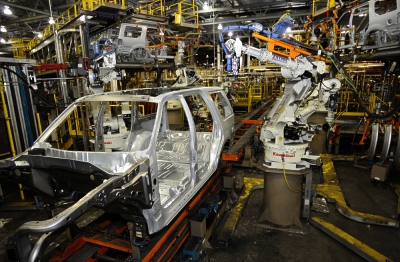
In 2010, Cuautitlan Assembly, which currently produces F-Series pickups, will begin building the new Fiesta subcompact car for North America. Louisville Assembly, home of the Ford Explorer mid-size SUV, is slated to start production of yet more unique small vehicles from the automaker’s global C-car platform the following year. At the heart of this manufacturing transformation is a flexible operation, which uses reprogrammable tooling in the body shop, standardized equipment in the paint shop and common-build sequence in final assembly, enabling production of multiple models in the same plant. |
Aiding the implementation of flexible manufacturing is Ford’s industry-leading virtual manufacturing technology. In the virtual world, engineers and plant operators evaluate tooling and product interfaces before costly installations are made on the plant floor. This method of collaboration improves launch quality and enables speed of execution.
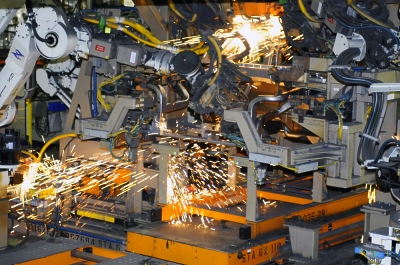
In a flexible body shop, at least 80 percent of the robotic equipment can be reprogrammed to weld various sized vehicles. This “non-product specific” equipment gives the body shop its flexibility and provides more efficient use of the facility.
In 2005, Ford invested $300 million in Michigan Truck to build a new, flexible body shop. That investment will help streamline the conversion to small vehicles and will require an additional body shop investment of approximately $75 million. This is part of a larger investment planned for the plant. Meanwhile, Ford continues to work with state and local governments on the scope of incentive support.
Today, nearly 87 percent of Ford’s assembly plants around the world have flexible body shops. By 2012, the number will grow to 100 percent.
Photos: Ford
(August 22, 2008)
| .
Homepage News Companies Management Publications Events Guestbook Search . |