|
.
All-New Ford S-MAX And Ford Galaxy Debut
At Geneva Auto Show
|
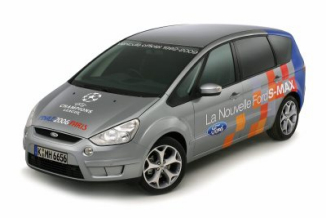
Ford S-MAX
-
All-new
model for Ford portfolio, sporty new interpretation
of people mover
-
Stylish,
spacious and versatile with sporty design
-
Ford FoldFlatSystem
(FFS); flexibility without the removal of any seats
-
Interior
provides 26 designed stowage compartments
-
Latest
driver assistance and occupant protection technology
- including driver's knee airbag
-
220PS 2.5-litre
turbo performance unit tops range of engines.
|
|
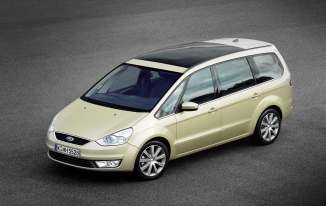
Ford Galaxy
-
Fully developed
and built in-house by Ford, unlike the previous model
-
Innovative Ford
FoldFlatSystem (FFS) allows 32 possible seating configurations
-
30 per cent more
luggage space than the previous model
-
Flexibility, modularity
and ample space for seven occupants
-
Four efficient
and powerful engines, impressive fuel economy and clean emissions
-
Comfortable and
dynamic suspension including continuously-controlled damping,
for car-like driving
-
Latest driver assistance
and occupant protection technology - including driver's knee
airbag
BRENTWOOD, Essex -
Ford Motor Company today announces the arrival of two all-new interpretations
of the modern people carrier. The sporty new Ford S-MAX and the
spacious new Ford Galaxy are launched at the 2006 Geneva Motor Show
and go on sale in June 2006.
While the new generation
Ford Galaxy takes the attributes of flexibility, spaciousness, and
safe and comfortable driving to new levels, the Ford S-MAX takes
Ford into a new market sector.
Both models have been
designed and developed in-house by Ford of Europe, and will be built
at the company's Genk Assembly Plant in Belgium . For the Galaxy,
this marks a major departure from the previous joint-venture model.
Both vehicles are also
significant in being the first to enter volume production with elements
of the company's new 'kinetic design' styling. First seen last year
in the striking Ford iosis concept car, this creative new form language
expresses energy in motion, and this is certainly true for the distinctive
shapes in the bold body forms of Ford Galaxy and Ford S-MAX.
While the new Galaxy
generation adds a dynamic angle to the vehicle's space credentials,
the crossover S-MAX clearly expresses more sporty ambitions.
The family face of
both vehicles shows their obvious relation, yet the only common
parts in the S-MAX's and Galaxy's external body panels are the head
lights and the front bonnet. They really are two distinctly different
vehicles - the Ford S-MAX roof height is about one hand width lower
than the Galaxy's (1607mm v 1676mm). All other body panels, as well
as doors and glass, are individual. Thus, each vehicle's distinguished
design style expresses its particular character.
Galaxy and S-MAX
innovations
New Ford Galaxy and
S-MAX feature a wide array of intelligent innovations, many of them
new to Ford, and many designed to provide superior levels of passive
and active safety.
Both offer a new Active
Suspension System with Continuously Controlled Damping (CCD) and
Adaptive Cruise Control with Forward Alert. An all-new driver's
knee airbag also debuts, along with a permanent Tyre Pressure Monitoring
System and an active Collision Mitigation System. Also, in keeping
with Ford's no-compromise approach to safety and the evolving EU
legislative requirements, measures have been taken to deliver an
increased level of pedestrian protection.
Galaxy and S-MAX:
space
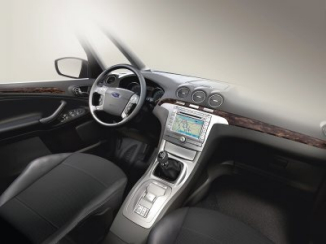
New Ford S-MAX and
Ford Galaxy are vehicles that take functionality and flexibility
to new heights.
Both new models feature
the Ford FoldFlatSystem (FFS). Easily moving and individually folding
second and third row seats bring new levels of flexibility and modularity
to the class. All seats remain on board, but can be folded down
to form a flat and even load floor almost as big - 2.0 metres by
1.15 metres - as a comfortable bed.
Both cars can be specified
with a large panorama glass roof, and the Galaxy also offers an
overhead console to enhance the "first-class travel" experience.
New Ford S-MAX and Galaxy also offer an optional sliding load floor
to help owners take advantage of its spaciousness for an active
lifestyle and easy loading.
Galaxy and S-MAX:
ride and handling
Ford created the new
S-MAX and its Galaxy with recognisable Ford dynamics yet key differences
in their driving characteristics. Each features Ford's signature
expertise in ride and handling - now summarised under the new title
Ford PrecisionDrive.
Galaxy's suspension,
offering more than 200mm of spring travel, is tuned for a much more
relaxed ride. The new S-MAX explores the sporty side of Ford's driving
dynamics, while giving away only 10mm of the Galaxy's overall available
jounce travel.
The sportier S-MAX
offers more precise ride and handling, and shows excellent performance
and controllable load-change reactions. The new platform's optimised
geometry provides a high level of torsional rigidity, which adds
to the car-like dynamic behaviour.
Both models can also
be specified with Ford's optional new active suspension system with
Continuously Controlled Damping (CCD). Ford's new CCD technology
effectively provides adaptive damping by rapid damper valve control.
This means that each damper valve can be adjusted almost every two
tenths of a second to guarantee the best interaction between comfort
and road contact. Heave, pitch and roll of the vehicle are controlled
by the system, improving handling and stability.
Galaxy and S-MAX:
safety
Ford has equipped both
all-new models with an array of active and passive safety features.
The safety story begins with a solid foundation - an ultra-stiff
body structure that reduces the deformation of the passenger safety
cell.
New safety systems
introduced in the Ford S-MAX and Galaxy include Interactive Vehicle
Dynamics Control (IVDC), and an all-new active suspension system
which integrates:
-
Continuously Controlled
Damping (CCD) to improve suspension performance and comfort
in all road conditions and interact with the vehicle's ESP for
better dynamic vehicle behaviour
-
Adaptive Cruise
Control (ACC) with Forward Alert (FA) and Collision Mitigation
by Braking - driver aids based on radar distance control
-
Hill-Launch-Assist
(HLA), which allows the driver to release the brake pedal and
to step on the accelerator pedal without the vehicle rolling
backwards
-
Ford's new Tyre
Pressure Monitoring System (TPMS)
Engines:
2.5-litre Duratec petrol
engine for S-MAX
For customers looking
for performance to match S-MAX's dynamic looks, this high-powered
five-cylinder turbo engine offers 220PS and peak torque of 320Nm
over a wide range from 1,500 to 4,800rpm. It will be mated to a
new Ford Durashift six-speed manual transmission.
2.0-litre Duratec HE
petrol engine
This 16-valve, four-cylinder
powerplant is available in both the Galaxy and the S-MAX, offering
145PS and peak torque of 190Nm. The powerful Duratec HE petrol 16-valve
engine is lightweight and compact, matched with Ford's proven MTX-75
Durashift five-speed manual transmission. Continued.
Duratorq TDCi 1.8-litre
diesel engine
This proven turbo-charged
Ford common-rail diesel engine is available for both Galaxy and
the S-MAX. It offers 125PS and a steady state peak torque of 320Nm
(340Nm under transient overboost). Also available in Galaxy only
is a power-reduced 100PS version of the Duratorq TDCi diesel to
suit the cost-of-ownership parameters driven by insurance and tax
rates in certain markets . Two transmissions will be available on
Galaxy, the Durashift MTX75 five-speed manual or the Durashift six-speed
manual. The S-MAX will be available with the Durashift six-speed
manual.
Duratorq TDCi 2.0-litre
diesel engine
Available in both the
Ford Galaxy and the S-MAX, this high-performance, 2.0-litre TDCi
diesel offers 140PS and a peak torque of 320Nm (340Nm under transient
overboost). It comes with Ford's Durashift six-speed manual transmission
as standard.
(February
20, 2006)
|


