
This Week:
-
Lexus Infuses Next Generation ES 300 with Unparalleled Luxury
. -
Intelligent systems from DaimlerChrysler will work hand in hand with human employees
. -
Porsche bids to double medium-term turnover in Asian/Pacific markets
. -
Paula Lillard Named General Manager, Toyota Motor Manufacturing, Alabama, Inc.
. -
New generation of Audi engines - Greater power, lower consumption
.
© 1998
- 2001 Copyright &
Disclaimer
Automotive Intelligence,
www.autointell.com
All Rights Reserved .
For questions please contact
editor@autointell.com

News of August 08, 2001
Intelligent systems from DaimlerChrysler will work hand in hand with human employees
The teachable robot as a production assistant
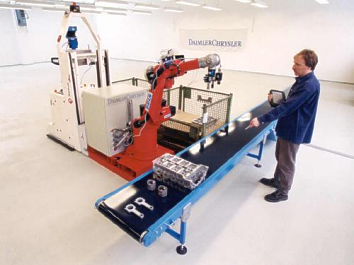
Photo: DaimlerChrysler
Stuttgart - The teachable robot by the name of Clever, developed by the DaimlerChrysler researchers in Berlin, can serve coffee: He finds his bearings in the room, reaches for a cup, avoids obstacles, operates the coffee percolator and brings the filled coffee cup to the designated person. Clever does not release the cup until he can feel that it is safety in the hand of the human recipient. What Clever can do today, his big brother – the production assistant – will be able to do tomorrow in automotive manufacture. He will be able not only to transport materials in a production hall, but also learn to adapt to new environments and tasks. A forerunner to this production assistant is the autonomous fork-lift truck – the first such system suitable for use in the factory.
The fork-lift truck as a robot
The autonomous fork-lift truck finds its own way into the production hall, locates the appropriate transport crates or parts and stacks them. By means of its infrared laser scanners – a two-dimensional unit at the bottom, and a three-dimensional unit at the top – the robot registers the immediate surroundings within a 180° field of 'vision' and determines which crates are to be picked up. If an obstacle should block the robot's path, it reacts within a fraction of a second and avoids a collision either by stopping or by moving around the obstacle.
It is important that the fork-lift truck carry out its work with 100 percent reliability. Since it operates autonomously, but in cooperation with human employees, it must not make a single error. This calls for highly refined technology: To compensate for any residual insecurity in handling the stacks, crates or parts, the robot makes use of special sensors and intelligent information processing. This ensures that it can reliably locate and transport objects such as crates, even if these are partly obscured. It is also aware of what it does not know or cannot do: Whenever necessary, it will call on help from its human colleagues. By this means, the robot can continue to learn from them. A further development of this system is the industrial production assistant, which will be used in automotive production in future.
An assistant in manufacture
The idea behind the mobile production assistant is to take on certain monotonous tasks in a complex manufacturing environment, or at least to make them easier for the human operator. The human is to be supported, but not replaced. This will also make manufacture more versatile and cost-efficient, since the can robot help in the automation of new tasks. In a publicly funded project, the scientists from DaimlerChrysler are investigating interaction and cooperation between the human operator and the robot. The human will ultimately be able to rely on the one- or two-armed robot as an intelligent helper, to whom he or she can designate specific tasks.
When the production assistant is relocated to a new environment, it does not have to be reprogrammed. Through the interaction with the human employee, it will learn to adapt to modified surroundings or new specific assignments.
Cooperation between the robot and the human operator The production assistant will help the human operator, for instance, by autonomously reaching for a component in a container, taking it to the appropriate work station and assisting in assembly. It then transports the component to an inspection or measurement station.
In order for the production assistant to carry out such tasks, it must be highly versatile: Factory environments frequently change, the locations of transport crates vary and the components in them are often neither sorted nor arranged. Only interactive, intuitive instruction by a human agent can enable the machine to act appropriately to the situation at hand: The human introduces the robot to the workplace environment, with its various specific locations and objects, and shows it how to dock to transport crates or take hold of components and materials. The production assistant can thus intelligently find its own way around and acquire the necessary sensomotoric skills. In all these activities, however, the robot remains under the control of the human operator. According to requirements, it can either participate in performing a task or operate fully autonomously.
In future, teams of robots will make the production process more versatile. Furthermore, they can provide support in passenger car sales: A robot will present various vehicles to the customer and stand at the ready to provide technical details.
(August 01, 2001)
[Homepage] [
News] [ Companies] [
Management] [ Publications]
[ Events] [ Careers]
[Services] [Discussion] [
Guestbook]
[ Search]